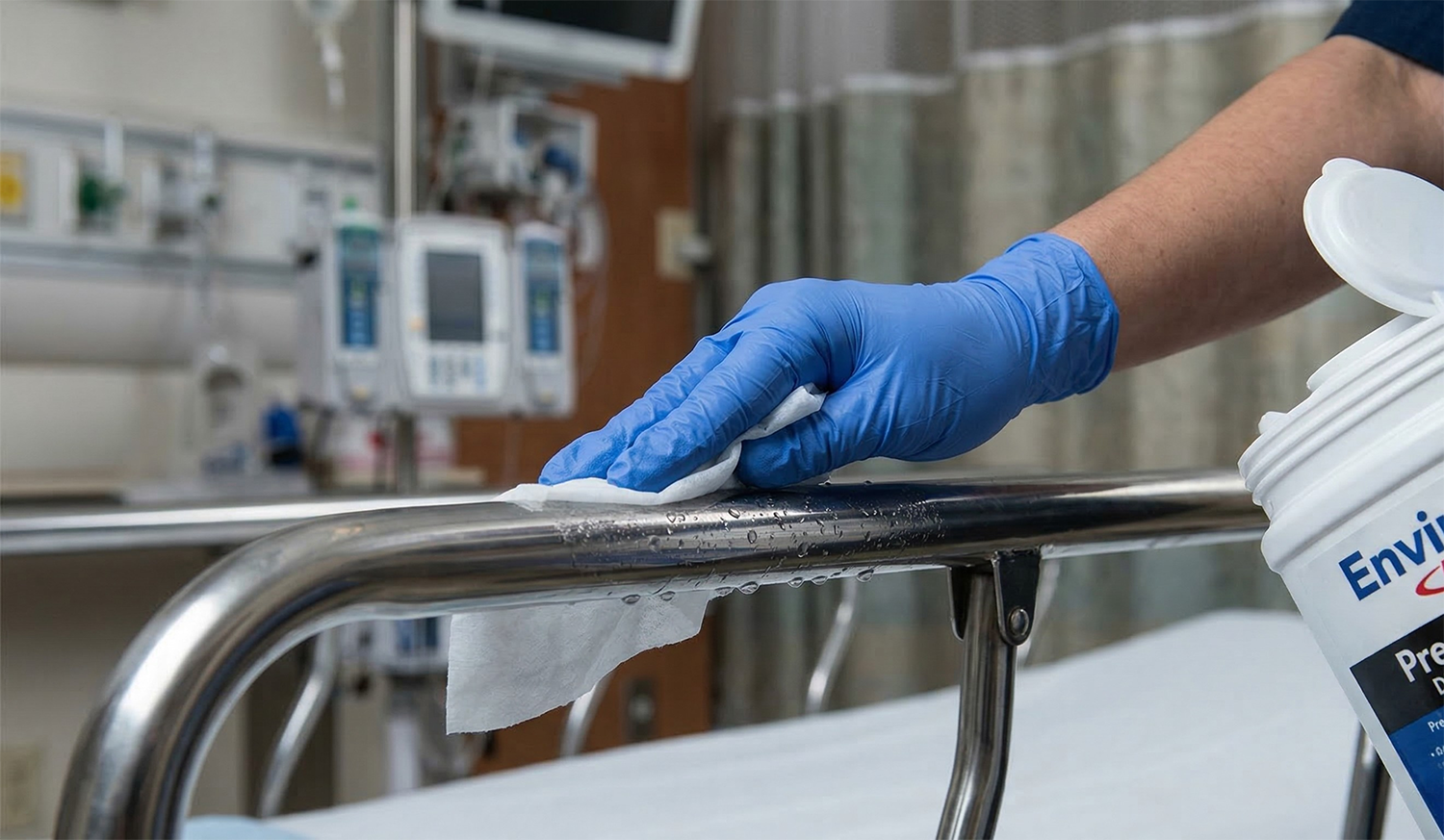
In a healthcare environment, cleaning and disinfection are not interchangeable. Removing visible soil is one step. Killing the pathogens that remain on surfaces after cleaning is an entirely different step. For environmental services teams in hospitals, clinics, long-term care facilities, and medical offices, choosing the right disinfectant is one of the most consequential decisions in the cleaning program.
This guide walks through what hospital-grade disinfectants for healthcare facilities actually require — what the terminology means, which specs matter most, and which products DP Supply carries that environmental services teams rely on.
Sanitizer, Disinfectant, or Sterilant: What Is the Difference?
These three terms are often used loosely, but they carry precise regulatory definitions that matter in a healthcare context.
Sanitizers reduce bacteria on a surface by at least 99.9 percent. They are standard in food service and food preparation environments, not in healthcare surface disinfection.
Disinfectants eliminate a broader spectrum of microorganisms, including bacteria, viruses, and fungi, on hard nonporous surfaces. Most hospital-grade disinfectants achieve a 99.999 percent or greater reduction in the presence of a defined list of pathogens. They are the standard for routine healthcare surface disinfection.
Sterilants destroy all microbial life, including bacterial spores. They are reserved for medical equipment and instrumentation processing, not routine surface cleaning.
For most healthcare surface disinfection work — patient rooms, high-touch surfaces, restrooms, and procedure areas — a properly selected hospital-grade disinfectant is the right tool.
What to Look for in a Healthcare Disinfectant
EPA Registration
Any disinfectant used in a healthcare setting must be registered with the U.S. Environmental Protection Agency. The EPA registration number on the product label confirms the product has been tested and approved for its stated claims. When evaluating a disinfectant, check the registration number and cross-reference it against the EPA’s list of approved products for the specific organisms your facility needs to address.
For facilities managing healthcare-associated infections or cleaning for emerging pathogens, the EPA’s List N is the current reference for products approved against specific viruses.
Spectrum of Kill
Not all disinfectants kill the same organisms. Before selecting a product, identify which pathogens are most relevant to your facility type. Key considerations include gram-positive and gram-negative bacteria such as MRSA and VRE, enveloped and non-enveloped viruses including influenza and norovirus, fungi and yeasts, and Mycobacterium tuberculosis, if applicable to your patient population.
A product’s label lists its specific kill claims. Never assume a disinfectant covers a particular pathogen unless the label explicitly states it.
Dwell Time
Dwell time is the amount of time a disinfectant must remain wet on a surface to achieve its stated kill claims. This is one of the most frequently overlooked factors in healthcare disinfection programs.
A product with a two-minute dwell time is not delivering the same pathogen reduction as a product with a four-minute dwell time if the surface dries before two minutes are up. In healthcare environments with heavy air circulation or warm temperatures, surfaces can dry faster than expected. When evaluating products, look for shorter dwell times for high-turnover areas such as patient rooms and exam rooms. EnvirOx products offer competitive dwell times alongside a broad spectrum of kill, making them a practical choice for high-frequency surface disinfection.
Surface Compatibility
Healthcare facilities contain a wide range of surface materials: stainless steel, plastic, vinyl, powder-coated metals, glass, and fabric. Not every disinfectant is compatible with every surface. Some formulas are corrosive to metals or degrade plastic when used repeatedly.
Before rolling out a new disinfectant facility-wide, verify surface compatibility against the materials in your facility. The product’s Safety Data Sheet and label will specify which surfaces the product is approved for.
Odor and Residue
Environmental services staff apply disinfectants in occupied and semi-occupied spaces, including patient rooms, nursing stations, waiting areas, and corridors. Harsh chemical odors affect patients, staff, and visitors. Products that leave behind sticky residue create issues on high-touch surfaces such as door handles, bed rails, and call buttons.
Betco and EnvirOx both offer formulations designed for healthcare environments that minimize odor and residue while maintaining full disinfecting efficacy.
How EnvirOx and Betco Support Healthcare Disinfection
EnvirOx is built around hydrogen peroxide chemistry, which is well established in healthcare disinfection. Their products are formulated to be effective against a broad spectrum of pathogens while being gentler on surfaces and people than older-generation disinfectants. The active chemistry breaks down into water and oxygen, reducing residue concerns and supporting a cleaner surface environment overall.
Betco offers a comprehensive line of healthcare-grade disinfectants and cleaners that address the full scope of environmental services needs, from daily disinfection of patient rooms to restroom sanitation and hard floor care. Their products are EPA-registered and carry kill claims across the organisms most relevant to healthcare facilities.
Both brands are available through DP Supply, Inc., with delivery across Central Illinois.
Common Mistakes in Healthcare Disinfection Programs
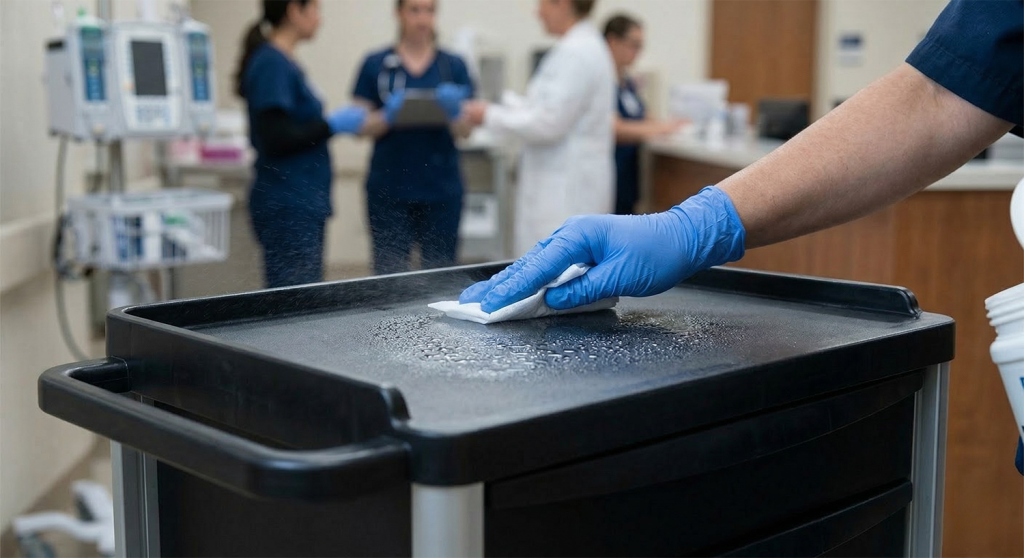
Not following dwell time. Wiping a surface immediately after application prevents the disinfectant from completing its work. Train environmental services staff to apply the product and allow the surface to remain wet for the full contact time before wiping or moving on.
Using the wrong dilution. Ready-to-use products eliminate dilution error, but concentrated products require precise mixing. A solution that is too weak will not achieve the stated kill claims. A solution that is too strong can damage surfaces and pose a safety risk to staff.
Skipping the cleaning step. Disinfectants are designed for use on clean surfaces. Organic soil, such as blood, bodily fluids, and heavy debris, can neutralize the active ingredient before it reaches the surface microorganisms. Clean first, then disinfect.
Using one product for every surface type. A disinfectant approved for hard nonporous surfaces is not necessarily appropriate for soft surfaces, upholstery, or patient equipment. Match the product to the surface and the application.
Inconsistent application across shifts. Disinfection protocols that vary by shift, department, or individual staff member create gaps in coverage. Written protocols with product-specific instructions help ensure consistent application facility-wide.
FAQ: Hospital-Grade Disinfectants for Healthcare Facilities
What is the difference between a hospital-grade disinfectant and a regular disinfectant?
A hospital-grade disinfectant carries kill claims against a broader and more demanding list of pathogens, including organisms commonly associated with healthcare-associated infections such as MRSA, VRE, and Clostridioides difficile. It must be EPA-registered with documented efficacy against those specific organisms. A general-purpose disinfectant may not carry the same spectrum of kill claims.
How do I know if a disinfectant is EPA-registered for healthcare use?
Check the product label for the EPA registration number. You can then verify the product and its approved uses on the EPA’s Pesticide Product and Label System database. For emerging pathogens, cross-reference the product against the EPA’s List N for virus-specific approvals.
What is dwell time, and why does it matter in a healthcare setting?
Dwell time is the minimum amount of time a disinfectant must remain visibly wet on a surface to achieve the kill claims on the label. If the surface dries before the dwell time is complete, the product has not delivered its full disinfecting effect. Training environmental services staff to respect dwell time is one of the highest-impact steps a facility can take to improve disinfection outcomes.
Is hydrogen peroxide-based disinfectant appropriate for healthcare environments?
Yes. Stabilized hydrogen peroxide formulations such as those used in EnvirOx products are well-suited to healthcare environments. They are effective against a broad spectrum of pathogens, have favorable surface compatibility profiles, and break down into water and oxygen, reducing residue and limiting chemical exposure for staff and patients.
Can DP Supply provide hospital-grade disinfectants for healthcare facilities in Central Illinois?
Yes. DP Supply, Inc. carries EPA-registered disinfectants from EnvirOx and Betco and delivers to Danville, Illinois, and the surrounding region within a 60-mile radius. Our team can help you identify the right products for your specific facility type and patient population.
Get the Right Disinfectants from DP Supply
Environmental services teams in healthcare settings carry real responsibility. The products they choose affect patient outcomes, staff safety, and regulatory compliance. DP Supply, Inc. carries the products that professional environmental services teams rely on, backed by over 100 years of experience serving facilities across Central Illinois.
Visit dpsupplyinc.com to explore our full selection of cleaning chemicals and janitorial supplies for healthcare environments, or call us at 1-800-821-2389. Our team is here Monday through Friday, 8:00 AM to 4:30 PM.